
‘Waiting for Godot’ Review: Keanu Reeves and Alex Winter’s Broadway Adventure
29 September 2025
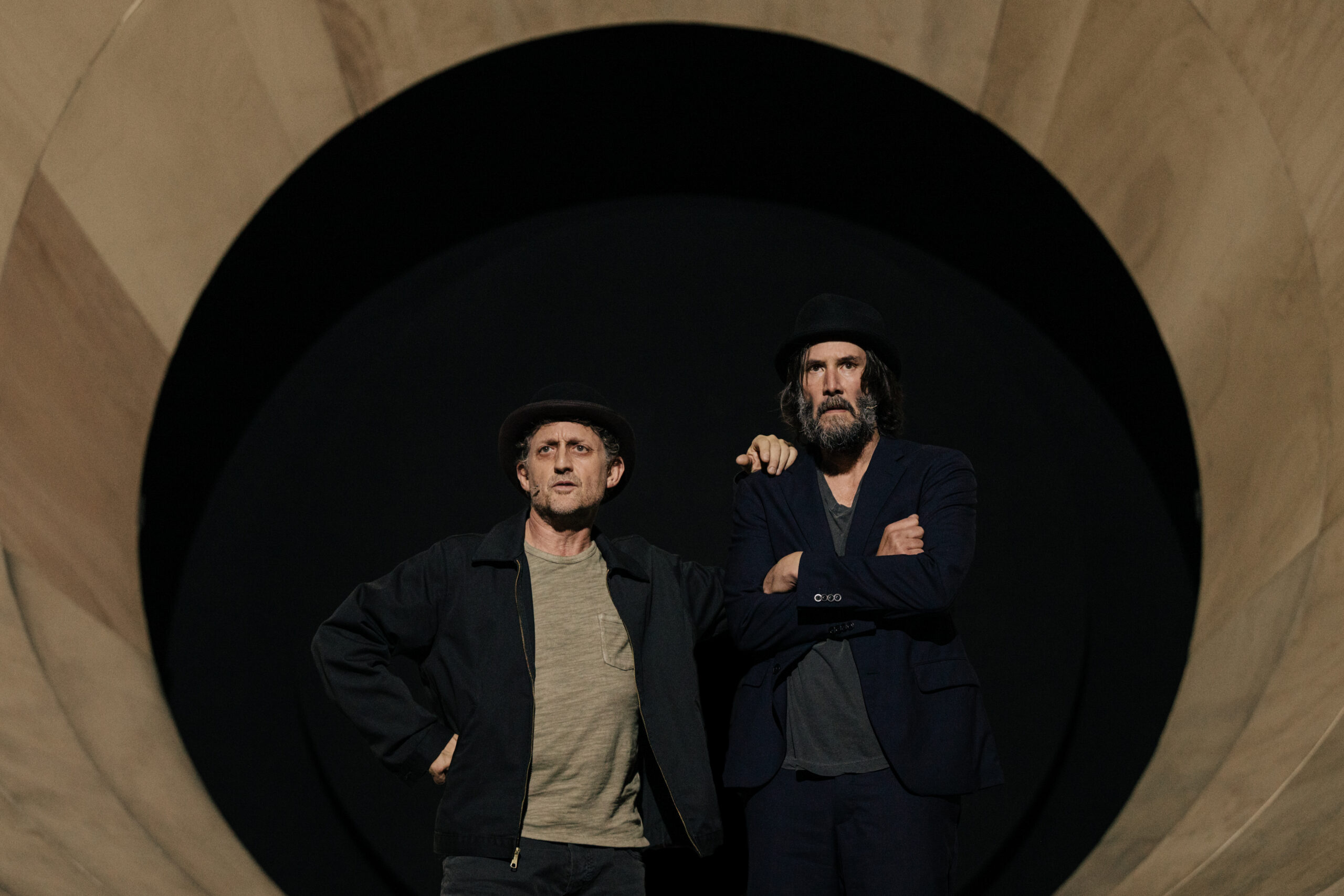
The ‘Bill & Ted’ stars lead a surprising, tender revival of Beckett’s absurdist masterpiece, directed by Jamie Lloyd.
Casting Keanu Reeves and Alex Winter, stars of the goofball comedy “Bill & Ted’s Excellent Adventure,” in Samuel Beckett’s “Waiting for Godot” sounds like an idea dreamed up by undergraduate theater nerds smoking strong weed.
But here we are, dudes. And while I entered the theater a skeptic, in fact the production, directed by the busy Jamie Lloyd, is not a gimmicky fiasco but a visually striking and unusually tender staging of the celebrated “tragicomedy,” which dramatizes the echoing loneliness of human experience.
There is something perversely funny in taking Bill and Ted, who zipped around the world via a magic phone booth, and dumping them in the straitjackets of Vladimir and Estragon, the bedraggled tramps who famously can’t seem to go anywhere, despite desperate vows to move on. But naturally the actors are not portraying them in the guise of the movie’s
endearing dolts.
Didi (Mr. Winter) and Gogo (Mr. Reeves) have their amusingly doltish moments, but the actors understand the assignment: not to give zany star turns for Bill and Ted fanatics, but to embody these hapless men who cannot get along but cannot part—emblems of the need for love and companionship, however irksome, in a world of inscrutable meaning, if any.
Mr. Lloyd is known for his radical productions, notably the Tony-winning revival of Andrew Lloyd Webber’s “Sunset Blvd.” Beckett was famously unforgiving when it came to fiddling with his works; his estate would not likely countenance egregious diversions from the “Godot” text. Mr. Lloyd has made modest changes. Soutra Gilmour’s set consists of a vast tunnel that dwarfs the characters, apt for a play that emphasizes the powerlessness of Didi and Gogo. There is no tree on stage: When they discuss, with deadpan practicality, the possibility of hanging themselves, they peer into the audience. The meager store of props—the vegetables that Didi and Gogo subsist on, the whip wielded by Pozzo (Brandon J. Dirden) to torment his slave, Lucky (Michael Patrick Thornton)—is absent. The contemporary costumes are more stylish than is customary—although the bowler hats and boots are present.
Hewing to the text, Mr. Lloyd elicits effective and affecting performances from the cast. Mr. Winter is superb as Didi, the marginally more decisive and inquisitive of the two principal characters. Among the most acutely moving moments is Didi’s interaction with the young boy (Eric Williams) who arrives at the close of the first act to announce that Godot, for whom Didi and Gogo have been antsily waiting, will not be coming today.
Mr. Winter’s pleading questions suggest both compassion (“You don’t know if you’re unhappy or not?” “You’re as bad as myself”) and a desperation to keep him from leaving—any company is welcome to alleviate the tedium of existence. The passage ends with a wrenching exchange, when the boy asks what he should tell Godot. Didi falteringly answers, “Tell him . . . tell him you saw us.” And then: “You did see us, didn’t you?” Mr. Winter brings to this crucial moment a sense of mournful confusion and despair that recurs throughout.
Mr. Reeves has never been one of the most expressive movie actors. With his face all but covered in a bushy, gray-flecked beard, his Gogo makes a milder impression than Mr. Winter’s Didi. But he proves a skilled physical comic, tussling with his boots or recoiling from a kick in the shins from Lucky. His Gogo gives a blank, uncomprehending thousand-yard stare into the void that has an unsettling power. And Mr. Reeves’s, um, sparing approach to expressing emotion befits the play. That said, the moment when Didi and Gogo throw themselves into a frantic hug—as if only by touching one another can they be sure they still exist—has breathtaking poignancy.
Mr. Dirden gives a brilliant performance as Pozzo, who breaks up the monotony of Didi and Gogo’s deadened existence when he comes upon them, hauled by Lucky, and settles in for a meal and some windy philosophizing. Mr. Dirden speaks with a majestic orotundity that evokes a preacher carrying around an invisible pulpit, and exudes a preening pomposity and
the requisite vicious abusiveness toward Lucky.
Mr. Thornton, who uses a wheelchair, also makes a strong impression. When forced by Pozzo to dance, Mr. Thornton merely doffs his bowler hat rhythmically a few times in a funny nod to Bob Fosse. And Lucky’s monologue—veering inanely through realms including religion, academics and sports—is delivered by Mr. Thornton not, as it usually is, as a galloping pile of gabble, but with a musing seriousness. The monologue mocks man’s attempts to attach meaning to existence, but this novel approach underscores that while men may never be able to find meaning in life, trying is a necessary, even noble pursuit.
With just a few deft strokes, Mr. Lloyd finds thoughtful ways of reinvigorating Beckett’s masterwork. The moonrise turning Didi and Gogo into black, ghostly silhouettes is one such touch. Most memorable is the exit of Pozzo and Lucky that finds Pozzo slowly pushing Lucky in his wheelchair—illustrating the idea that there remains a bedrock of humanity even in this supercilious boor. He needs Lucky as much as Lucky needs him, just as Didi and Gogo cling to each other to keep going amid their despair, even as they go nowhere.